Beautetrade.com
3 min Read
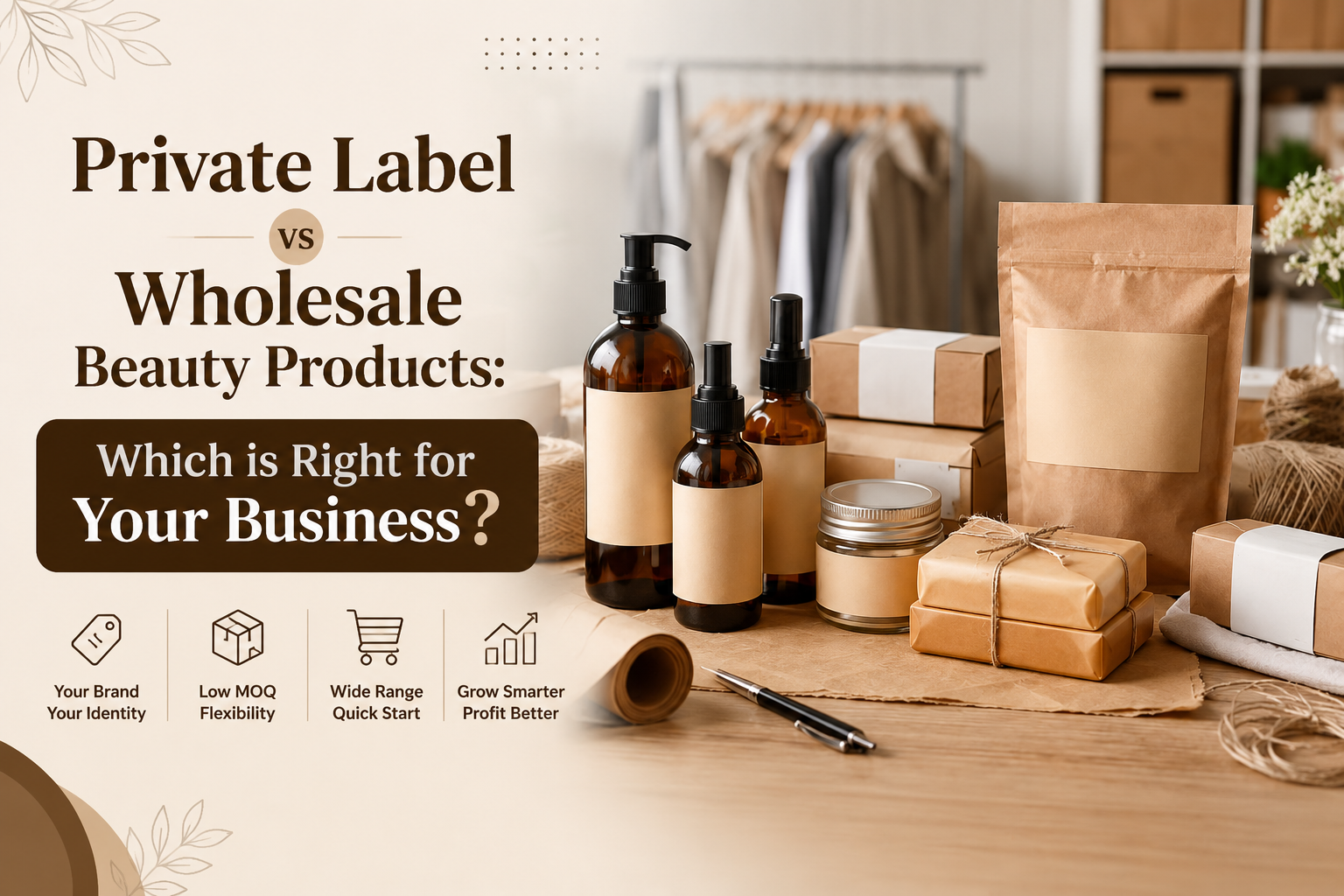
Choosing a good business model to run a beauty business may determine how far your business will go, in terms of profitability, branding, and even future success. In many instances, there are two main options you can choose from: the private label model and the wholesale beauty products business model. The private label model involves selling beauty products under your own label or brand, while the wholesale beauty products model involves buying ready-made beauty products and selling them.
However, the main question that arises is which model should you choose for your business? The main difference between private label beauty products and wholesale beauty products is that private label cosmetic products are tailor-made according to your specifications, while wholesale beauty products have already been branded and created. In this guide, we will discuss the key difference between private label and wholesale products and which model is right for your business. Continue reading to learn more in detail!
Private label beauty products are products that have been produced by a manufacturer under your own brand name. Rather than inventing your products from scratch, you collaborate with a private label cosmetics manufacturer who has products or formulas available to offer. You decide on the products, packaging, labeling, as well as particular features or ingredients.
The sourcing of private label beauty products involves finding a trustworthy private label manufacturer. You will need to select the products, ask for samples, choose the packaging, put your logo on it, and place an order. This business model is quite common for private label beauty product companies.
For example, you may opt for an existing facial serum, put your brand name and packaging, and offer the product within your line of skincare products.
Brand ownership: You build your own brand instead of selling someone else's brand.
Custom packaging: You can create packaging that matches your brand style.
Higher profit margins: You have more control over pricing and product positioning.
Customer loyalty: Customers can connect directly with your brand and may return for your products.
Higher startup costs: You may need money for packaging, samples, inventory, and branding.
Longer production times: Manufacturing and packaging can take more time than simply buying ready-made products.
Minimum order quantities (MOQs): Some manufacturers require you to purchase a certain number of units.
Yes, the process can be profitable in the beauty industry if the right products, the right supplier, correct prices, and target market are selected. Beauty products may yield good margins, but this will depend on the cost of production, packaging, marketing, distribution, and sales volume. It is also easier to price the products because you are selling private label products without having to compete with similar brands.
As per the private label guide by Shopify, the margin of private label products is higher due to more control over pricing and branding. Good beauty product sourcing and careful cost planning are important for long-term success.
Beauty product wholesale refers to already-made products that can be bought in bulk from a supplier in exchange for less money and then sold to consumers. In this case, you normally do not develop your own product or formula. What you do is select the products that exist in the market and sell them through your store, website, salon, etc.
Purchasing wholesale beauty products involves several stages. Firstly, you need to find a reliable wholesaler of cosmetics. Secondly, you should study the range of products offered by the wholesaler, their prices, the minimum quantity required, quality, and delivery options. After selecting your products, you buy them in bulk and sell them at retail price.
Types of wholesale beauty products may include skincare products, makeup, hair care products, lotions, cleansers, serums, and beauty tools. Businesses looking for a range of wholesale beauty products can explore suppliers on BeauteTrade to find products suitable for their target market. The platform has a huge network of wholesale beauty product suppliers who offer reliable cosmetic products at market-competitive rates.
Less capital investment: You do not need to invest in the production of your products.
Quick availability to the market: Ready-to-market products can help you make sales fast.
Existing Product Demand: Your products may already have some existing consumer demand.
Poor Branding: You will be selling products of other brands.
Low Profit Margin: You might not set your prices according to your wish because of your suppliers and competition.
Competitive Market: Many other sellers can have the same products as yours.
When comparing private label vs wholesale beauty products, think about what matters most to your business. Private labeling gives you greater control and branding opportunities, while wholesale focuses on simplicity, speed, and lower starting costs.
|
Feature |
Private Label |
Wholesale |
|
Branding |
Your own brand name and identity |
Existing brand or supplier's products |
|
Startup Cost |
Usually higher |
Usually lower |
|
Profit Margin |
Potentially higher |
Usually lower |
|
Customization |
High; packaging and some product details can be customized |
Limited |
|
Market Entry |
Takes more time to prepare |
Faster to launch |
|
Customer Loyalty |
Strong potential because customers connect with your brand |
More difficult to build around your own brand |
In the case of private label cosmetics, you are free to develop an image that will represent your brand and its offerings. It is possible to pick up the packaging, product name, and positioning that will help to attract your target clients and thus develop a beauty brand.
A wholesale approach is simpler. You can pick up already developed products and start selling them without developing something from scratch. That is why it may be a good idea for entrepreneurs who want to enter the market and test their ideas. It is necessary to take into account your financial limitations as well as your business plans. If you want to develop a brand, private labeling may suit you better. If your aim is to sell products quickly, a wholesale approach seems to be preferable.
You dream of having your own cosmetic brand: With private labeling, you will be able to produce your own branded beauty products.
You think about developing your business: This type of cosmetic manufacturing may help you add new lines to your products and attract more loyal clients.
You wish to get unique products: You will be able to choose unique packaging, and even product formula depending on the manufacturer.
Choosing private labeling can be particularly beneficial for those who want to build their own beauty brand.
You are on a tight budget: Manufacturing your own cosmetic products will require higher investments.
You need fast results: You may offer products immediately.
You are trying to get an insight into the market and clients' preferences: Wholesale may be used when you want to study the market.
Wholesale can be particularly helpful if you are new to the beauty industry.
Yes, it is possible to integrate these two models and develop a hybrid beauty business model. These models may be helpful for those who want to start on a smaller scale and eventually establish their own brand.
For example, you may start by selling wholesale beauty equipment or products to study the needs of the market and make some profits. When you identify the demand for some products, you can start selling private label products under your own brand name. This way, you can experiment with your brand before investing heavily.
The hybrid model may also help you diversify your product range. You can continue offering certain wholesale products while gradually introducing your own skincare, makeup, or hair care products.
Choosing between private-label and wholesale beauty products depends on your budget, branding goals, and business strategy. Wholesale is a simple and affordable way to start selling beauty products quickly, while private labeling gives you greater control over branding, customization, and long-term growth. If you want to build a strong beauty brand, private labeling may be the better choice. If you want to test the market with less risk, wholesale can be a good starting point. You can also combine both models as your business grows.
Ready to build your beauty business? Evaluate your goals and choose the model that aligns with your vision!
 Most Popular