Beautetrade.com
10 min Read
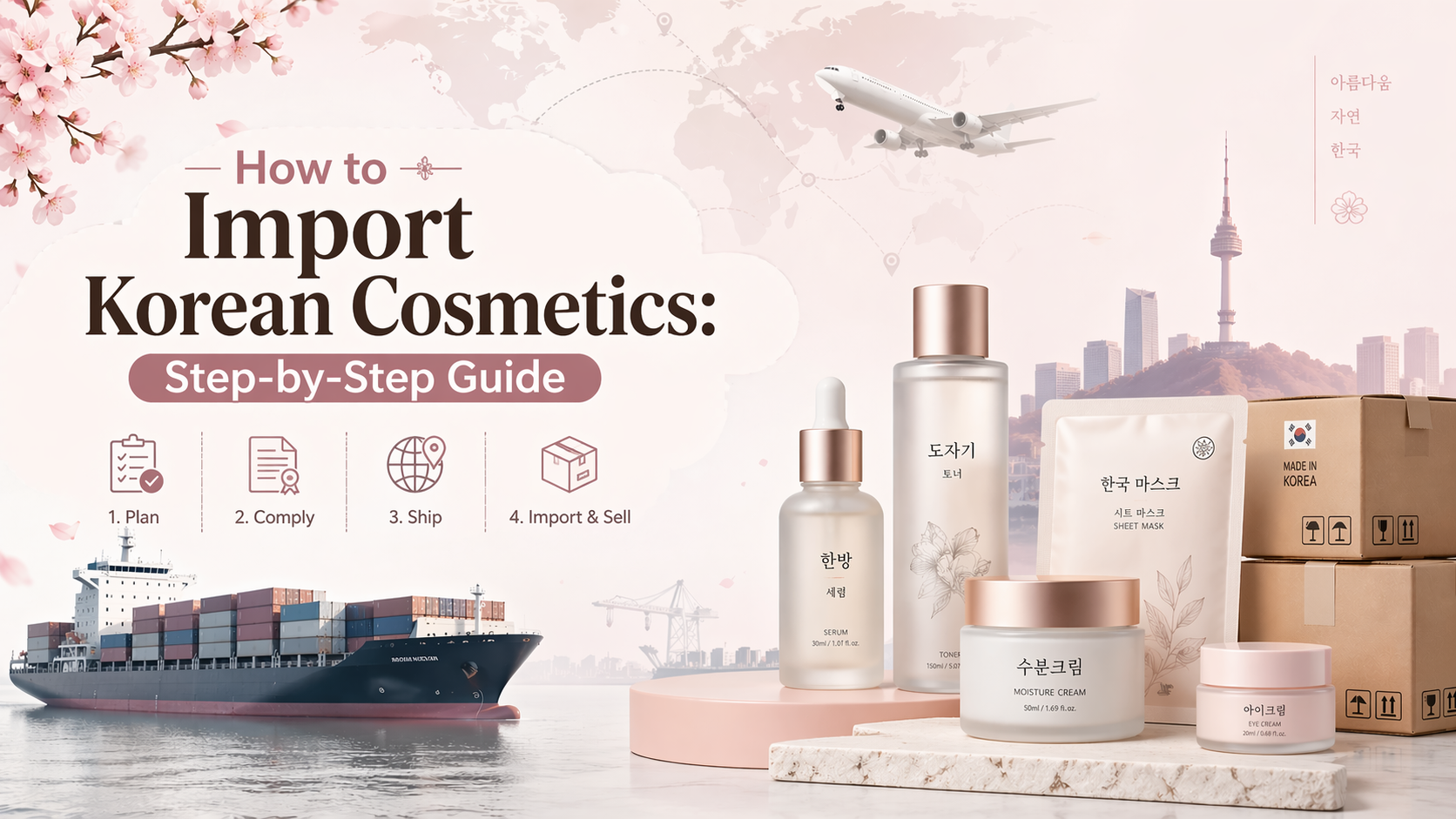
The cosmetics sector is a multibillion-dollar industry experiencing explosive demand, driven by social media platforms such as TikTok, Instagram, Snapchat, and Facebook. Consumers no longer see cosmetics as a luxury. It has become a daily need, covering skincare, haircare, makeup, and fragrances.
This is perhaps one of the few industries that is demanded by all women aged 16 to 60 and beyond. This is why the women's cosmetics industry is gaining strength day by day. Still, it's been observed that men, particularly Gen Z (true digital natives heavily influenced by new media), are increasingly using cosmetics. It’s still an untapped market, owing to rising demand and a supply shortage (as more and more are shifting to women's cosmetics).
South Korea is the market leader in cosmetics, despite tough competition from Japan (J-Beauty), France, the US, Switzerland, and Italy; it remains No.1 and has strong demand worldwide. K-Beauty focuses on achieving glass skin and an ultra-glow look, using organic ingredients and comparatively lower prices.
China was the biggest importer of Korean products. Until recently, the United States of America became the top importer worldwide, surpassing China, as the market witnessed a decline in Chinese demand for K-Beauty due to hostility and negativity towards South Korean products.
Other top importers with strong demand for South Korean products include Japan, Vietnam, Russia, Taiwan, the UAE, and Poland.
Given the high demand for Korean cosmetics, let me explain, step by step, how to import K-Beauty products with ease.
K-Cosmetics' uniqueness and excellence are achieved through a unique combination of innovation, natural ingredients, and highly functional packaging, and due to this rare combination, they can compete and win against the world's most formidable competitors, such as Japan, the USA, China, France, Italy, Germany, and Thailand.
Their innovation-first approach, with a focus on achieving “glass skin” and an “ultra luminous look” using organic ingredients, and the unique packaging that is lightweight, easy to carry, and appealing in design, has made it stand out from the rest of the pack.
The overall K-Beauty Market is at a whopping $15 billion and is growing stronger than ever. This proves that the South Korean Market rise is not just a temporary trend, surpassing $10–11 billion annually, and there is astonishing growth in these numbers. This clearly shows that more and more consumers are trusting and buying South Korean cosmetics and coming back to buy again and again.
A major reason behind this stunning growth is the speed at which Korean cosmetics brands launch new products, keeping in mind the changing consumer tastes and preferences.
This guide is for distributors and wholesalers who want an easy, step-by-step yet comprehensive plan to import Korean Cosmetics, from buying products in Korea to selling worldwide.
If you wish to sell in any part of the world, you need to understand how the K-Beauty supply chain actually works, how to find reliable Korean suppliers, and simple yet powerful steps to effectively import South Korean cosmetics at lower prices so you remain competitive.
Before you dive into importing Korean cosmetics, you need to clearly understand your responsibilities and the law to avoid any inconvenience. Broadly speaking, there are 2 main types of importers, and they are explained here.
Brand Importer: This is fairly easy to start, entails low risk, and consumers already trust the brand. This is often recommended for importing without prior experience, as it's generally safe.
Private Label: This is a High Risk, High Reward model, where you create and launch your own brand, but a Korean manufacturer actually makes the product. Here, you enjoy more control and profits, but it comes with risks.
When importing Korean Cosmetics, you need to be 100% clear about the concept of “Responsible Person”. In simple words, who would be held responsible and can be taken to court if anything goes wrong?
Despite the huge risks, the top priority is Private Label, as it's more rewarding: they can control prices and enjoy a monopoly.
If you want to find reliable Korean Cosmetics Suppliers, you don't need to go too far; luckily, there are specialized directories and B2B Platforms where Korean Cosmetics manufacturers, distributors, wholesalers, and suppliers list their products. The key is not to get lost in general B2B Platforms that list all sorts of products; instead, find specialized platforms focused on skincare and cosmetics, which will eventually save you a lot of time and effort.
One obvious example is Beautetrade.com, a B2B Platform focused on the beauty and cosmetics industry. The key benefit of using a specialized platform like this is that you will instantly find K-Cosmetics suppliers without much hassle.
It's usually a user-friendly, straightforward process on Beautetrade: you just create a buyer's profile, search for a Korean cosmetics supplier, and send an RFQ. It is advisable to request a sample first, as it will allow you to test the product's quality and packaging before placing a large order.
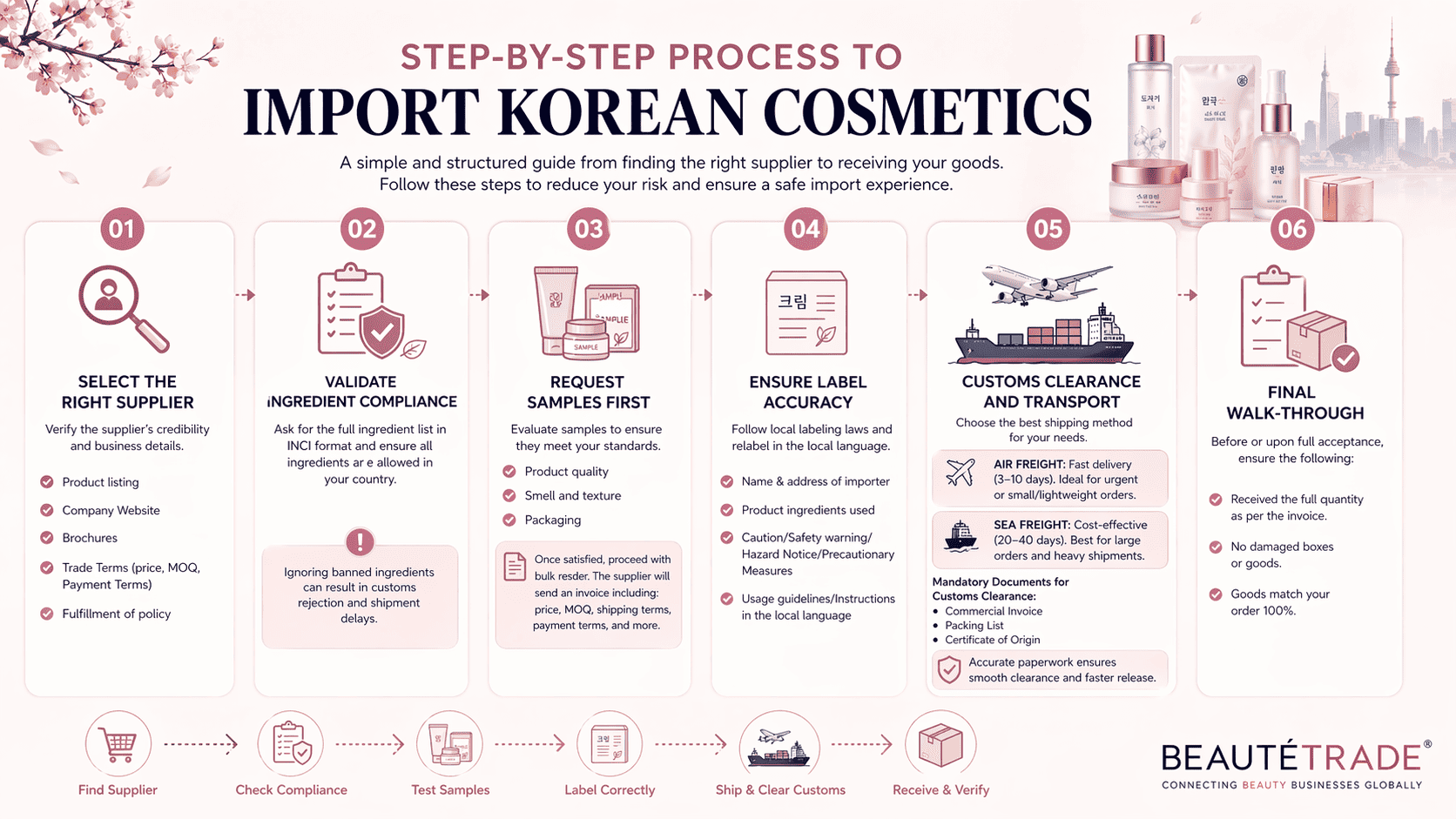
Importing K-Cosmetics becomes much easier when you follow a structured process.
Let us walk you through a step-by-step guide from finding your ideal supplier to receiving your goods. Follow these steps to reduce your risk and ensure a safe import experience.
The first step is always important, as the rest of the process depends on this. So it is always better to identify the right partners, which is crucial for success; you can start by reviewing our list of the top Korean cosmetics wholesale suppliers and distributors currently dominating the market in 2026. At this stage alone, you can decide the direction of your business. To select a reliable supplier, you need to first verify their:
K-Cosmetics continuously relies on product innovation and often uses natural ingredients. Importers often make the grave mistake of assuming that the products approved for import into Korea will be allowed into their countries. Not every country allows Korean ingredients.
It is strongly advised to always ask for a full ingredient list in INCI (International Nomenclature of Cosmetic Ingredients) format. This is your checklist to see if anything is not permitted or banned in your importing country. Ignoring this could result in your shipment being permanently held by customs.
When placing a major order, always request samples to test the product's quality and packaging. Some suppliers can send you free samples, but you may need to pay for them if they are not included with the order.
Order the samples to evaluate:
Before you commit to a production run, it is vital to understand the difference between K-Beauty OEM vs ODM manufacturing models to determine which level of customization your brand requires. Once you are fully satisfied, you can go ahead with bulk ordering. The supplier will then send you an Invoice, which should include:
Every country has its own labeling policy, so your packaging must follow local labeling laws. The product must be relabeled in the local language, stating the product name, expiry date, distributor information, and usage instructions.
Labels are required to display:
Now choose how the products will be shipped based on your unique requirements.
For customs clearance, the documents mentioned below are mandatory :
With accurate paperwork, smooth customs clearance, and a faster release, this is ensured.
Once the customs clearance is successful, the shipment will be released for delivery. Before or upon full acceptance, it is advised to :
If you are ready to begin sourcing immediately, you can post a buying lead for Korean cosmetics to receive direct quotes from verified exporters.
The prerequisite for importing Korean cosmetics is 100% certainty that the products are safe, thoroughly tested, and manufactured in a clean environment. This is where verified records and documentation come in. This helps prove that the products meet strict quality standards and can be legally imported into your country or target market.
The certifications listed below clearly indicate that the products are manufactured in a hygienic environment.
Every country follows its distinct rules and regulations. From A to Z, you must strictly abide by the rules of the country where you intend to sell.
These documents explain what exactly is inside the product and whether it is completely safe.
MSDS (Material Safety Data Sheet): A document that explicitly explains how to handle the product safely, with advice on storage and shipping, companies must exercise caution when shipping hazardous or flammable products or any risky ingredients.
COA (Certificate of Analysis): A report for a particular ‘batch’ of product so it accurately matches the approved formula and is free of heavy metals or harmful bacteria. It is evidence that the product has been tested and is safe.
Ingredient Compliance: Every ingredient must be thoroughly checked against your company’s banned list. If a product is allowed in Korea, it doesn't necessarily mean it's allowed in your target market, so you must thoroughly check it.
When importing Korean cosmetics, choosing the right shipping method is critical.
It depends on your order size, budget, and urgency, as well as which option you prefer.
It's a fast but expensive option, used when you have an urgent need to receive your products due to peak demand. It is typically used for:
For instance, if a product goes viral on social media, if demand increases during a special event or season, or if you run out of stock, then Air Freight is considered the best option.
It's rather slow but cost-effective when you want to import large quantities of products. It is typically used for :
There is a lot more cost involved when importing Korean cosmetics than just the product price. The supplier price is usually not the final price you pay, and many additional costs are incurred before the products reach your warehouse.
Make it standard practice to request a DDP (Delivered Duty Paid) quote, so you receive the final amount that includes shipping, taxes, and customs duties.
To understand the true cost per unit, consider the following 5 factors.
Product packaging must be translated into the local language and labeled with stickers to meet the legal requirements.
You must register your brand with the health department or obtain a safety certificate.
This may include :
Importing Korean Cosmetics is profitable if you follow a certain set of rules and regulations. But if you are not careful, your products can be permanently held by customs.
Let’s highlight the importers' mistakes so you can avoid them.
Every country has its own specific compliance rules to be followed. A product that is allowed to be sold in Korea must still pass through a strict process before it can be sold in your target market.
K-Products usually use natural ingredients, but if certain organic ingredients are allowed to be sold in Korea, it doesn’t mean they can be sold elsewhere. A certain lotion can be sold in South Korea, but its preservatives may be banned in your country, leading to rejection of your shipment.
Labeling rules are quite strict in many regions, yet importers use local-language labeling, which can result in shipment rejection or hefty penalties. So if the product is in Korean or English and your country's laws require labeling in the local language, you must add local-language labeling stickers.
Missing or incomplete important entailments entail significant consequences; ignoring them can result in financial loss, as your shipment may be permanently held up.
Korean Cosmetics exports have reached approximately $8.8 billion in 2024. This staggering figure is encouraging enough for the K-Cosmetics Distributors and Retailers, and despite the rules and regulations, it entails enormous profits if one follows the proper steps.
 Most Popular
 Editor's Pick
 Related Products


![[the SAEM] URBAN DELIGHT Body Lotion - Citron, Skin Care, 400ml, Korean Cosmetic](https://www.beautetrade.com/uploads/images/products/3/6/the-saem-urban-delight-body-lotion-citron-skin-care-400ml-korean-cosmetic1-0590539001554212826.png)
![[Secret Key] Skin Refreshing Nature Toner 248ml - Korean cosmetics](https://www.beautetrade.com/uploads/images/products/4/0/secret-key-skin-refreshing-nature-toner-248ml-korean-cosmetics0-0878418001554213456.png)